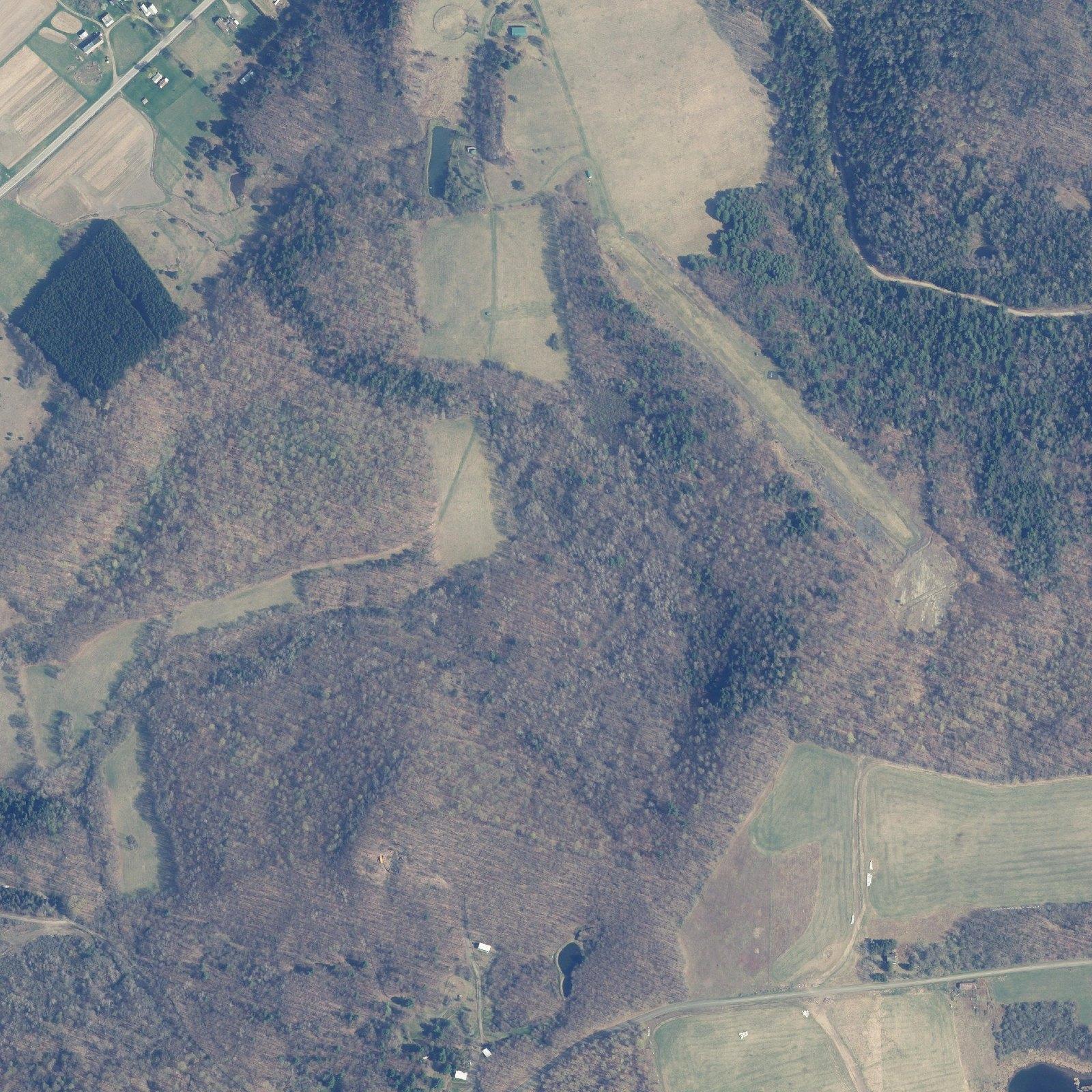
Leaf-off: NYS ITS orthoimagery. Plan as drawn by DECOHunt (Claude Opus 5.5), Oct 26 2026. One road name removed.
One real plan
Seventeen items, each with its reason.
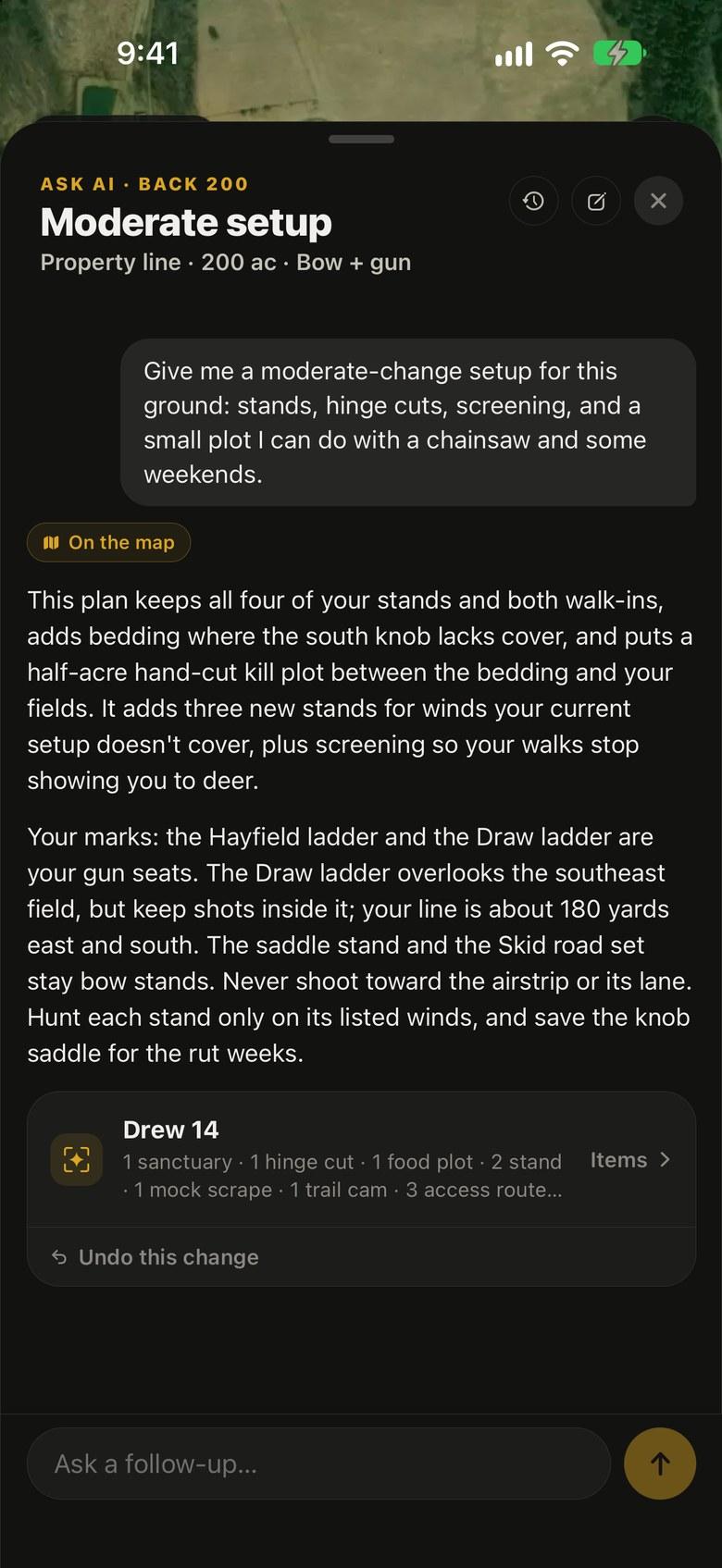
“Give me a moderate-change setup for this property. I bowhunt it and my dad gun hunts it. I have a chainsaw and some weekends.”
01 · CorridorMedium confidence
Cleared lane in from the west neighbor
Deer from the pine plantation and woods to the west follow this cleared strip and its edges into the middle field and the saddle.
Leans on Travel corridors, funnels, and pinch points
02 · CorridorMedium confidence
Hemlocks to the saddle to the conifer draw
The rut route between the two bedding areas runs through the saddle. That's why the plot stand is the best all-day seat in November.
Leans on Travel corridors, funnels, and pinch points · Buck movement through the rut
03 · FunnelHigh confidence
Saddle at the south end of the middle field
The bare-earth relief shows a dip about 11 feet lower than the ridge on either side, right where the field meets the woods. Deer crossing between the hemlock side and the big south and east woods walk through it.
Leans on Travel corridors, funnels, and pinch points
04 · SanctuaryHigh confidence
East conifer draw above the steep bank
The thickest, darkest cover on the place, tucked in a draw with a 50-foot bank on its northwest side. It is the farthest spot from the house to the north and from the road, which makes it the mature buck bed. Never enter it, not even to track or check a camera.
Leans on Where whitetails bed and why · How hunting pressure changes deer movement
05 · BeddingHigh confidence
Hemlock creek bottom under the north field
Thick hemlock along the creek and the steep north- and west-facing banks. Does and young bucks bed here within 100 yards of the hayfield. Never walk through it. Every route stays east or north of it.
Leans on Where whitetails bed and why
06 · Hinge cutMedium confidence
Hinge pocket in the open hardwoods west of the middle field
Bare, open timber with no understory sits between the hemlocks and the middle field, 100 to 150 yards from food. Hinge maple, ironwood, and hophornbeam in the 4 to 10 inch range, and leave two or three escape lanes open. In two seasons this becomes a third bedding pocket that empties east into the kill plot, upwind of the plot stand on a west or northwest wind. Cut in late winter.
cut late winter; bedding by year two
Leans on Creating bedding and cover with hinge cuts and timber stand improvement · Where whitetails bed and why
07 · StandHigh confidence
Kill plot corner over the saddle
Bow stand, hang-on or saddle, just inside the woods at the plot's southeast corner. It sits about 25 yards from the saddle and covers deer stepping into the plot from the hinge pocket and the west lane. On a west or northwest wind your scent drifts into the big open south woods, away from both bedding areas. Bow only.
Hunts NW · W · Nevenings early season and pre-rut; all day late Oct to mid Nov
Leans on Stand placement, wind, thermals, and access · Setting up for bow versus gun · Travel corridors, funnels, and pinch points
08 · Ladder standHigh confidence
North hayfield, southeast corner
Dad's gun stand. It looks across the whole hayfield to the north and west, where deer leaving the hemlock bottom step out in daylight. Your property line is over 200 yards out in front, and the airstrip is off to the right and behind, so he doesn't shoot that way. The hemlocks sit upwind on a west wind. It works for a bow only if deer use the field's east edge.
Hunts W · NW · SWgun season, evenings; opening morning
Leans on Setting up for bow versus gun · Houses, roads, and safety setbacks · Stand placement, wind, thermals, and access
09 · Ladder standMedium confidence
Corner of the southeast field below the conifer draw
This one serves both of you. The trail out of the conifer draw passes within bow range on its way to the field, and the ladder looks over the field's interior for a gun. Keep gun shots to the field inside your line, which is about 150 yards east and south. The house to the southwest is over 1,100 feet away and behind the stand. On a northwest wind your scent blows out over the field, away from the bedding.
Hunts NW · W · Nevenings; bow pre-rut, gun season late
Leans on Setting up for bow versus gun · Where whitetails bed and why · Houses, roads, and safety setbacks
10 · Saddle standMedium confidence
Old skid road under the airstrip
Bow stand about 20 yards off an old logging road cut across the west-facing slope, the one that shows up on the bare-earth relief. Bucks use it as an easy route between the north field and the conifer draw at dawn and while cruising in the rut. Hunt it only on a south or southwest wind, never west or northwest, which would carry your scent into the sanctuary.
Hunts S · SWmornings and midday, late Oct to mid Nov
Leans on Travel corridors, funnels, and pinch points · Buck movement through the rut · Stand placement, wind, thermals, and access
11 · Mock scrapeMedium confidence
Mock scrape in the saddle
Hang a licking branch about five feet up on the plot edge where the saddle trail enters, about 24 yards from the stand. It holds passing bucks in bow range in the pre-rut.
build early October
Leans on Water, mock scrapes, staging areas, and camera placement · Buck movement through the rut
12 · Trail camHigh confidence
Camera on the saddle scrape
Set it just south of the scrape, facing north so the low sun never washes it out. Check it only on the way in to the plot stand.
Leans on Water, mock scrapes, staging areas, and camera placement
13 · Walk-inHigh confidence
Field gate to the gun ladder and the kill plot
Walk from the farm lane gate down the east edge of the hayfield behind the screen, cross the ditch east of the farm track, and come into the plot stand from the north. You stay east of the hemlocks and well west of the sanctuary.
Leans on Stand placement, wind, thermals, and access
14 · Walk-inMedium confidence
Farm lane up to the southeast field
Come in on the farm lane along the east edge of the field and follow the field's north edge to the ladder. You never get near the conifer draw.
Leans on Stand placement, wind, thermals, and access
15 · Walk-inMedium confidence
Along the airstrip to the skid road
Follow the southwest edge of the airstrip in the dark, then drop down the slope to the stand. On the south winds this stand needs, your scent goes out over the runway, away from both bedding areas.
Leans on Stand placement, wind, thermals, and access
16 · Food plotMedium confidence
Kill plot in the south end of the middle field
Take the south third of the middle field and plant it as a narrow plot right against the saddle. Deer from the hinge pocket, the hemlocks, and the cleared lane all stage here before the bigger fields. A northwest wind runs down its length toward the stand at the southeast end. Mow and spray the rest of the field to keep it open.
plant brassicas by mid-August
Leans on Food plots, kill plots, and screening cover
17 · ScreenMedium confidence
Switchgrass strip down the east edge of the north field
Plant a 20-foot strip of switchgrass, or Egyptian wheat for the first year. It hides the walk from the field gate to the gun stand and on to the kill plot, so deer feeding in the hayfield never see you come in.
Leans on Food plots, kill plots, and screening cover · Stand placement, wind, thermals, and access
When and where to sit. Reads DecoCast for the days you ask about and your stands, ranks every stand by wind for every sit, and plans the walk in.
02
Ask about the ground
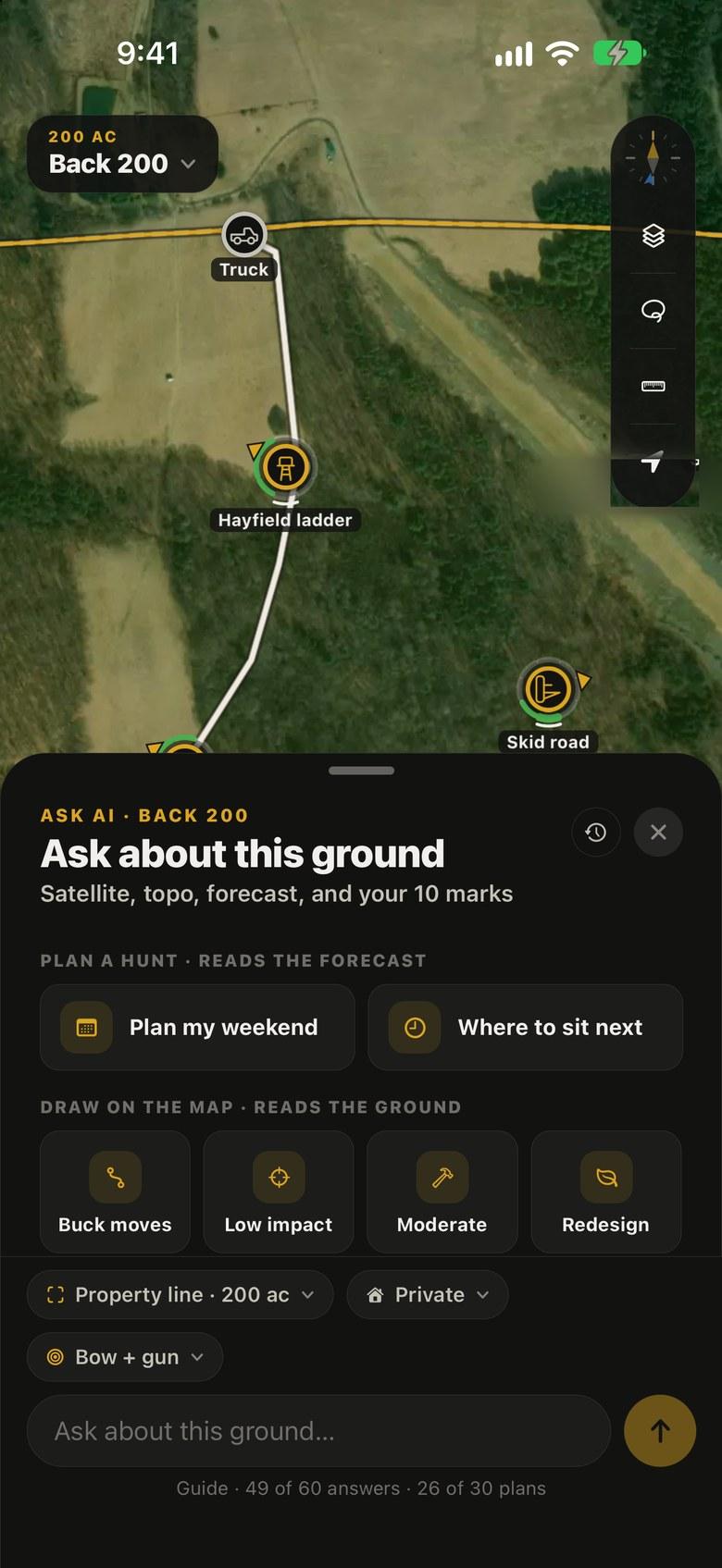
Where would deer bed? Why is this corner dead? Answers in words and can light up to four places on the map.
03
Plan
Draws a setup for the ground: stands, bedding, corridors, plots, cuts, walk-ins. Your own marks are left alone.
04
Revise
“Move that stand off the field edge.” Changes the open plan and keeps the conversation.
05
Redesign
Rethinks the whole property, and can suggest taking your marks down. You accept each change.
Hunt it
Sit by sit, with the walk in.
Ask where to sit and it reads DecoCast for those days and every stand’s winds, then answers sit by sit. A sit with no good wind says stay out.
Ask AI · Back 200
Where to sit next
Property line · 200 ac · Bow + gun
Where should I sit next, and how do I get in and out?
Monday: south wind in the morning fits only the Skid road, then a NW wind in the evening fits the hayfield and the draw. Tuesday is an all-day sit with the cold front at midday: saddle first, then the hayfield ladder for the best window.
Mon · Evening59
Hayfield ladder
Hayfield ladder on a WNW wind
WNW 11 mphGood windBest 5:00–6:31 PM
The wind fit is good, and the 5:00 to 6:31 window is the best of the day. A WNW wind blows from the field toward the woods, so it carries your scent away from deer coming out of the timber. Gusts of 23 mph are strong, so expect scent to swirl. Hold off on the Saddle stand and the Draw ladder tonight, since they fit too, and save them for Tuesday.
Walk the Gate walk-in from the Truck and keep your steps quiet along the wooded edge, not out across the open hay. At dark, wait for deer to leave the field, then slip out the same way without using a light.
Tue · All day63
Saddle stand
Saddle stand through the midday
NNW 7 mphGood windBest 4:00–6:00 PM
Tuesday is an all-day call, and bucks move through the middle of the day in the seeking weeks. The morning wind is marginal here, but it is light and from the NE. The saddle is the funnel between the two fields, so it’s the best spot to stay put through the midday. The cold front around noon turns the wind to the north. That fits this stand and the evening fit is good. Your camera at the saddle will show what’s been passing through.
Walk in on the Gate walk-in before first light, going slowly. This route crosses the field edge, so wait until you’re in the trees before turning on a light. If you want to leave for lunch, go quietly. Stay put if you can, since midday movement is higher than normal today.
Ask a follow-up…
Real app output from our test ground in New York. Your ground and your forecast will differ.
What it can draw
A fixed vocabulary, drawn for hunters.
Every item has a type, a place, a reason, how sure it is, and the research behind it. Stands also carry the winds they hunt.
Stand
Blind
Bedding
Sanctuary
Funnel
Staging
Hinge cut
Food plot
Screen
Water hole
Mock scrape
Trail cam
Walk-in
Corridor
How hard to work it
Low, moderate or aggressive.
The tiers are physical work and money. You pick one when you ask. The 17-item plan on this page is Moderate.
Low impact
No habitat work. Stands, access and timing.
Moderate
Plus hinge cuts, screening and small plots.
Aggressive
A full redesign: big plots, timber work, sanctuary, water. Drawn when you ask for it.
How a plan is made
What it looks at
Your outline (or the screen) becomes a square frame. The server renders it as satellite and as topo, adds a 1 m LiDAR shaded relief of the bare earth (our own tiles in New York, the USGS elevation service elsewhere) and, in New York, the leaf-off photo. Code finds benches, old road cuts, saddles, ditches and steep banks in the LiDAR and hands them over as places.
What it knows about you
Every mark inside the area, your stands and the winds they hunt, any plan already open, and your hunt log boiled down by code: totals per stand, and the dozen or so sits most like the days you’re asking about.
What it knows about deer
A knowledge base of our own notes on published deer research (Penn State’s Deer-Forest Study, Mississippi State’s Deer Lab, USDA NRCS habitat guides, buck GPS-collar studies), loaded whole into every plan. Items cite the notes they lean on.
Who does the thinking
Plans are drawn by Anthropic’s Claude. Before your first question the app asks your permission to send it; you can take that back in Settings. Items stream onto the map one by one in 30 to 90 seconds, never behind a frozen spinner.
What it won’t do
Touch your marks. A plan is its own layer; tapping Accept copies an item onto your map. Over about 2,000 acres it asks you to zoom in instead of guessing. It doesn’t police regulations: plans are suggestions, and the rules and land access are yours.